AI-POWERED AUTOMATION PLATFORM
Corporate Social Infrastructure for Enterprise Teams
A SaaS platform designed to structure internal corporate engagement — beyond calendars, chats, and spreadsheets
60%
Faster Decisions
10K+
Automated Tasks
99.9%
Uptime
AI Accuracy
99.7%
Real-time Ops
1.2M/s
Project Overview
INFRA-STRUCTURE FOR ENTERPRISE CORPORATE SOCIAL
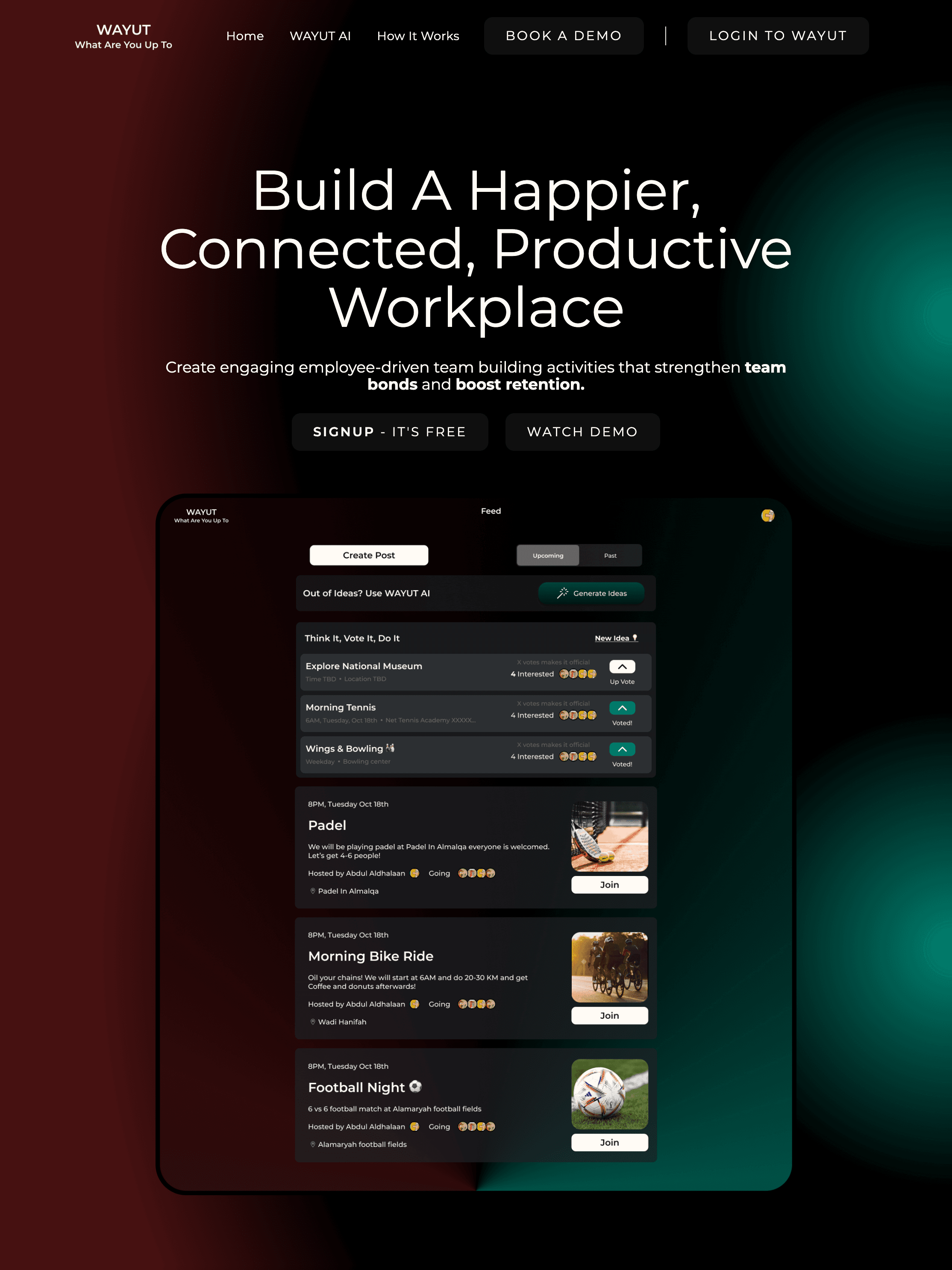
WAYUT is a corporate engagement platform designed to structure internal social activities inside organizations.
Unlike traditional tools built for operational meetings, WAYUT focuses exclusively on non-work corporate events — from sports activities and reading clubs to company-wide celebrations.
The platform centralizes planning, availability coordination, voting workflows, and event lifecycle management inside one scalable SaaS system. Built from scratch over 365 days by a 3-engineer team, WAYUT delivers enterprise-ready architecture without legacy constraints.
AI / SaaS
Industry
2024
Year
Web / Cloud
Platform
B2B Enterprise
Type
The Challenge
THE PROBLEM
WE SOLVED
Modern organizations rely on work-oriented tools to manage internal social activities. These tools were never designed for structured engagement workflows at scale.
01
Fragmented Coordination
Internal events were managed through chats, spreadsheets, and ad-hoc polls. There was no centralized system to structure the full event lifecycle.
02
No Structured Event Flow
From idea generation to voting and final confirmation, there was no consistent process to manage engagement activities.
03
Availability Conflicts
Teams struggled to align schedules. Manual coordination created confusion and low participation rates.
04
Lack of Visibility & Scalability
As organizations grew, informal coordination methods became unsustainable. There was no scalable infrastructure for corporate social engagement.
Product Experience
UNIFIED EVENT
COORDINATION CENTER
A centralized dashboard to manage corporate social activities, coordinate availability, control voting flows, and track event participation. Designed for clarity, predictability, and structured engagement at scale.

WAYUT Platform
Event Control Dashboard
Live System
Active Tasks
2,847
AI Models
24
Data Streams
156
Success Rate
99.7%
Deterministic Scheduling Logic
Multi-user availability comparison with conflict resolution and state-controlled voting flows.
Lifecycle State Management
Clear event state transitions from draft to confirmation and execution.
Modular Backend Architecture
NestJS-based domain separation supporting independent scaling and controlled service isolation.
Core Features
WHAT WAYUT
ENABLES
Five core capabilities that transform internal corporate coordination into structured, scalable infrastructure.
Structured Event Lifecycle
Controlled event states from idea to confirmation, replacing fragmented coordination with predictable workflows.
< 100ms response
99.7% accuracy
Self-learning
Deterministic Scheduling
Rule-based availability resolution and voting logic eliminate ambiguity in multi-user planning.
200+ integrations
Real-time sync
Auto-mapping
AI Event Suggestions
Context-aware assistant generating relevant event ideas without interfering with core logic.
Visual builder
Smart triggers
Error recovery
Modular Backend Architecture
Domain-separated NestJS structure enabling safe feature expansion and refactoring.
1M+ ops/sec
Auto-scaling
Edge computing
Enterprise-Ready Security
OAuth authentication and role-based access control built for organizational deployment.
SOC 2 certified
GDPR compliant
Zero-trust
Our Approach
HOW WE BUILT
WAYUT
A structured engineering process that transformed an idea into an enterprise-ready SaaS platform over 365 days.
01
Problem Framing
Traditional scheduling for group activities relies on informal coordination: message threads, manual time comparison, and subjective agreement. In growing organizations, this approach becomes non-deterministic. WAYUT required a scheduling mechanism capable of:
Deliverables
Comparing availability across multiple users
Supporting voting-based decision flows
Handling time-slot conflicts predictably
Maintaining consistent state across devices
02
Domain Modeling
Before implementing UI interactions, we defined the scheduling domain model. Each event contains a structured collection of candidate time slots. Each participant can mark availability states that map into a deterministic evaluation matrix. The system does not “guess” optimal dates. It computes them.
Deliverables
Event & Participant
Time Slot & Vote State
Availability State
Resolution Outcome
03
Availability Matrix Computation
At the core of the engine lies a multi-dimensional availability matrix.
Deliverables
Rows represent participants
Columns represent candidate time slots
Cells represent availability states
04
Deterministic State Transitions
Every event progresses through explicit states. State transitions are not UI-driven. They are rule-driven. This prevents inconsistent event conditions, especially when multiple users interact simultaneously across devices.
Deliverables
Draft
Open for Voting
Aggregating
Confirmed & Locked
05
Frontend Synchronization Strategy
The React frontend was structured to separate. Server-driven updates trigger recalculation of derived scheduling outcomes. The UI layer reflects computed results rather than mutating business logic locally. This separation prevented race conditions and reduced unexpected edge-case behavior on mobile devices.
Deliverables
Server state (availability & votes)
Derived resolution state
UI interaction state
Development Timeline
365-DAY
ENGINEERING JOURNEY
From zero codebase to enterprise-ready SaaS platform.
Months 1–3
Architectural Foundation
The project began with system boundary definition and domain modeling.
Authentication flows, database schemas, and API contracts were defined early to prevent structural rework later in the lifecycle.
Core entities such as events, teams, participants, availability states, and voting logic were formalized before UI implementation started.
This phase focused on long-term maintainability rather than rapid feature accumulation.
Months 4–6
Event & Scheduling Engine
The most complex subsystem — availability resolution — was implemented during this phase.
Multi-user scheduling logic, voting aggregation, conflict detection, and deterministic state transitions were developed and tested incrementally.
Frontend architecture matured alongside backend modules, ensuring that scheduling computation remained predictable across devices and user interactions.
Months 7–8
AI Integration Layer
AI functionality was introduced as a contextual suggestion engine rather than embedded within deterministic workflows.
The assistant was designed as an independent orchestration layer capable of analyzing team interests, location context, and time constraints.
Isolation between probabilistic AI outputs and deterministic scheduling logic was preserved to maintain system stability.
Months 9-11
System Stabilization & Refactoring
As feature completeness approached, focus shifted toward structural refinement.
Code reviews intensified. Type discipline was enforced more strictly.
Unstable components were replaced with modular abstractions.
Performance bottlenecks were identified and resolved without altering architectural boundaries.
Month 12
Production Readiness & Deployment
System hardening
Deployment configuration under Saudi domain requirements
Security validation
Integration testing across modules
The result was a scalable MVP ready for enterprise-level adoption.
Technical Architecture
BUILT FOR
ENTERPRISE SCALE
Presentation Layer
Presentation Layer
Presentation Layer
Presentation Layer
API Gateway & Access Layer
Authentication & Authorization
Request Routing
Rate Limiting
Session Validation
Domain & Service Layer
Event Management Module
Availability Resolution Engine
Voting & State Control
AI Suggestion Orchestrator
Integration Services
Data Layer
Structured relational data
Session & temporary state caching
Media & assets
Scalable Deployment Model
The architecture supports horizontal scaling and containerized deployment strategies. Service isolation allows scaling specific modules without affecting the entire system.
Modular Service Design
The backend follows a modular NestJS architecture. Domains such as events, users, scheduling, and AI orchestration remain isolated, allowing independent evolution and safer refactoring.
Deterministic Processing Core
Availability resolution and voting aggregation operate through rule-based computation rather than UI-driven heuristics. This ensures predictable outcomes regardless of user concurrency.
Controlled Integration Strategy
External services (calendar synchronization, authentication, location APIs) are abstracted behind service adapters. This prevents vendor lock-in and reduces integration fragility.
Team & Collaboration
TEAM & COLLABORATION FOCUSED
ENGINEERING TEAM
A compact 3-engineer team delivering full-stack ownership across architecture, frontend, backend, and AI integration.
A compact 3-engineer team delivering full-stack ownership across architecture, frontend, backend, and AI integration.
Frontend (React), Backend (NestJS), AI Integration, Availability Engine, DevOps & Infrastructure Production Deployment
DevOps Ownership
Internal DevOps, Architecture–Deployment Alignment CI/CD, Cloud Infrastructure
Product & Design (Customer)
Product Management, Roadmap & Priorities, Figma UX Direction, Direct Collaboration
Iterative Development Cycles
The system evolved through structured development phases with continuous feedback and incremental refinement. Instead of delivering isolated features, architectural decisions were revisited as complexity increased.
Shared Architectural Ownership
There was no isolated “frontend-only” or “backend-only” ownership. Architectural decisions were validated collectively to prevent inconsistencies between UI logic, API structure, and scheduling computation layers.
Continuous Refactoring
Given the evolving product requirements, refactoring was not postponed to a final stage. Code quality, typing discipline, and modular separation were reinforced progressively throughout development.
Production-Oriented Mindset
The team approached WAYUT not as an experimental MVP but as a production-grade SaaS system from the beginning. Security, deployment constraints, and domain-level scalability were considered early rather than retrofitted later.
Project Facts
Industry
HR Tech / Corporate Engagement
Platform Type
SaaS (Web / Cloud)
Architecture
Modular Cloud-Based Architecture
Deployment
Enterprise Cloud Deployment
Technology Stack
CUTTING-EDGE
TECH STACK
30+ technologies carefully selected for performance, scalability, and developer experience.
Frontend
React
Framework
TypeScript
Language
Tailwind CSS
Styling
Vite
Build Tool
React Query
Data Fetching
Backend
Node.js
Runtime
Python
Language
FastAPI
Framework
GraphQL
API
API
Real-time
AI/ML
TensorFlow
Framework
PyTorch
Framework
OpenAI API
LLM
Hugging Face
Models
MLflow
MLOps
Infrastructure
AWS
Cloud
Kubernetes
Orchestration
Docker
Containers
v
IaC
GitHub Actions
CI/CD
Data
PostgreSQL
Database
Redis
Cache
Apache Kafka
Streaming
Elasticsearch
Search
S3
Storage
Monitoring
Prometheus
Metrics
Grafana
Visualization
Sentry
Error Tracking
DataDog
CloudWatch
Logs
Impact & Results
ІMPACT & RESULTS ENGINEERING
BUSINESS IMPACT
WAYUT transformed informal, fragmented coordination into structured corporate infrastructure.
365 Days
From zero codebase to enterprise-ready SaaS platform.
3 Engineers
Full-stack ownership across architecture, scheduling engine, AI integration, and deployment.
Deterministic Scheduling Engine
Replaced manual coordination with rule-based availability resolution and transparent voting flows.
Modular Architecture
Built to evolve without structural redesign as product complexity increases.
Key Outcomes
WAYUT delivered a structured coordination system where internal events follow defined state transitions rather than informal communication threads.
The platform introduced predictable availability resolution, reducing ambiguity in scheduling and eliminating fragmented planning across chats and spreadsheets
AI functionality enhanced ideation without compromising architectural stability, operating independently from deterministic business logic.
The final system matured into a production-ready SaaS platform prepared for enterprise deployment under domain-specific constraints.
"SUP.AI transformed how we operate. What used to take our team hours now happens automatically in seconds. The platform doesn't just automate tasks — it makes intelligent decisions that improve our business every day."
Michael Chen
Chief Operations Officer
Enterprise Technology Company
More Projects
Next Project
AI-Powered Analytics Platform
Real-time business intelligence platform that transforms raw data into actionable insights using AI.
View Case Study
READY TO BUILD
THE FUTURE?
Let's create something extraordinary together. Transform your business with AI-powered automation.
Enterprise-Ready
24/7 Support
Global Scale
SOC 2 Certified
Custom Solutions